Tall Vertical Columns with / without internals About
Tall Vertical Columns with / without Internals
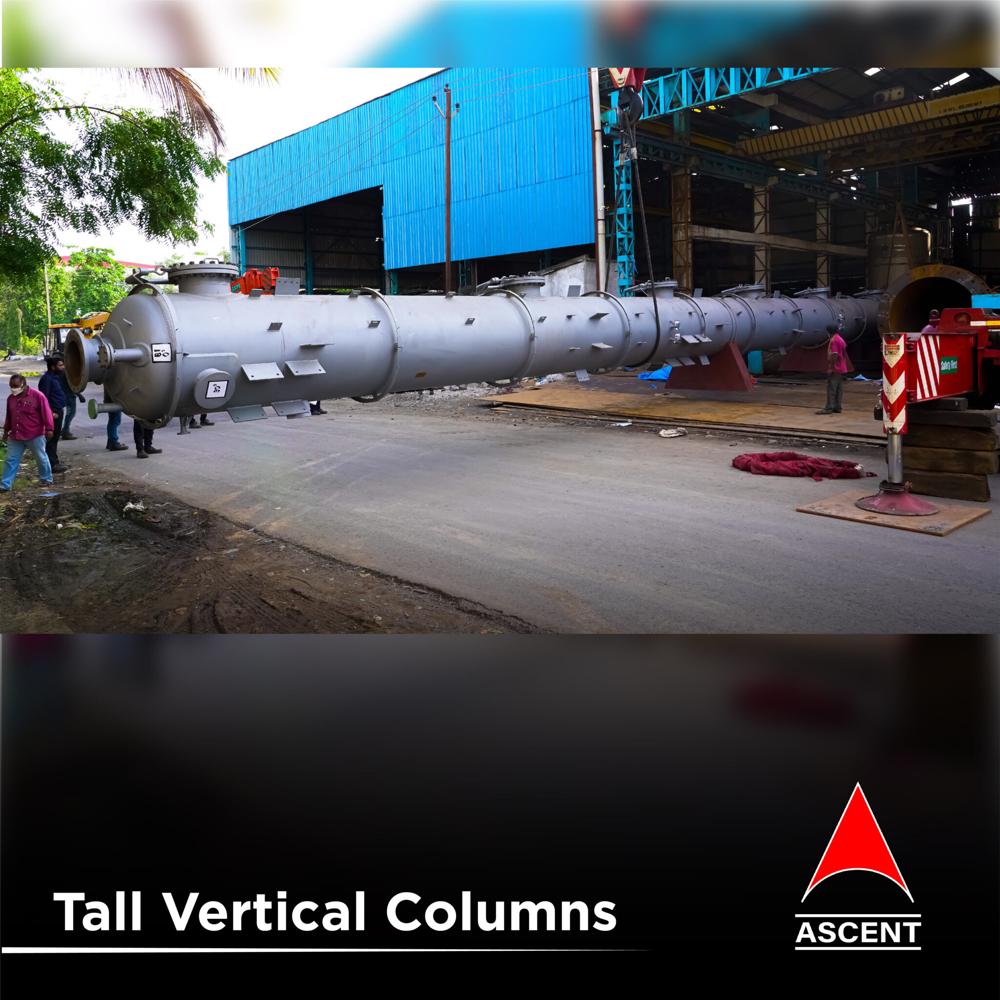
Ascent Machineries & Engineering Services manufactures, supplies, and exports high-quality Tall Vertical Columns with or without Internals designed for efficient separation, distillation, absorption, stripping, and other process operations. These columns are engineered with robust construction and precision fabrication to provide reliable performance under demanding industrial conditions.
Our Tall Vertical Columns are available in heights up to 50 meters and diameters ranging from 500 mm to 5,000 mm. They are designed to operate within a temperature range of -50C to 400C and pressure conditions from vacuum up to 50 bar. Columns can be supplied with customized internals such as trays, packing supports, distributors, demisters, and other process components as required.
Key Features:
-
Height up to 50 meters
-
Diameter: 500 mm to 5,000 mm
-
Temperature range: -50C to 400C
-
Pressure range: Vacuum to 50 bar
-
Available with or without internals
-
Robust and durable construction
-
Customized design and fabrication
-
Suitable for continuous industrial operation
-
Precision-engineered for reliable performance
These columns are suitable for chemical, petrochemical, pharmaceutical, fertilizer, refinery, specialty chemical, and process industries. Ascent Machineries & Engineering Services provides customized column solutions based on specific process parameters, capacity, material, and operating conditions.
Wide Material and Pressure RangeThese vertical columns can be crafted from a variety of premium materials including stainless steels, carbon steels, alloy steels, duplex, and super duplex grades. Designed to operate under full vacuum and pressures up to 100 bar, they are suitable for harsh chemical and petrochemical environments, adapting to challenging process requirements with ease.
Advanced Internals and AccessoriesColumns can be supplied with trays (sieve, valve, bubble cap), random or structured packings, demister pads, and a variety of process-specific internals. Additional features such as ladders, platforms, insulation cladding, and heating jackets further enhance functionality to fit unique operational needs.
Quality Assurance and ComplianceEvery column meets stringent codes like ASME, IS, DIN, PED, and TEMA, and undergoes rigorous testing, including hydrostatic, pneumatic, radiography, and ultrasonic methods. Corrosion allowances, insulation, and surface finishes (mirror, matt, sandblasted, or coated) are provided per project specification, ensuring reliability and long service life.
FAQ's of Tall Vertical Columns with / without internals:
Q: How are the tall vertical columns customized for different applications?
A: Columns can be tailored based on process requirements, covering size, pressure, and temperature specifications, as well as the choice of internals (trays, packings, demisters), surface finishes, insulation, and material selection. Automation integration options such as PLC or DCS controls are also available if required.
Q: What processes are these columns primarily used for?
A: Tall vertical columns are primarily used in operations like distillation, absorption, stripping, extraction, and fractionation. They are essential in chemical, petrochemical, pharmaceutical, and oil & gas industries where precise and large-scale separation or purification is needed.
Q: When is it necessary to select special materials or surface finishes?
A: Special materials or surface finishes are chosen based on process media, temperature extremes, required corrosion resistance, and compliance needs. For corrosive environments or high-temperature operations, alloys, duplex steel, or specialized coatings are typically recommended to ensure performance and durability.
Q: Where can these columns be installed and what industries benefit most?
A: These columns are installed in processing plants, refineries, and industrial facilities worldwide. Core industries that benefit include chemical manufacturing, oil & gas, pharmaceuticals, and petrochemicals, where robust, high-capacity separation equipment is vital.
Q: What is the process for quality assurance and compliance verification?
A: Each column undergoes a comprehensive quality control process, including hydrostatic, pneumatic, radiographic, and ultrasonic testing. Compliance with international codes like ASME, PED, DIN, and TEMA is strictly maintained, with full documentation provided as per client or regulatory requirements.
Q: How does automation benefit the operation of these vertical columns?
A: Automation (via PLC or DCS integration) provides precise control over operating parameters, enhances safety, increases efficiency, and simplifies process monitoring. Automated columns are particularly advantageous in large or complex facilities, reducing manual intervention and risk of error.







 Send Inquiry

 Send Inquiry
 Send Inquiry
 Send SMS


 English
 Spanish
 French
 German
 Italian
 Chinese (Simplified)
 Japanese
 Korean
 Arabic
 Portuguese